In today’s business-driven world, conferences are no longer just any ordinary gathering but a moment of branding. Every detail from the executive summit and business meetings to global product launches affects impressions. However, sometimes most planned AV events can go wrong due to overlooked conference AV challenges, turning crucial moments into expensive disruptions.
Imagine audio cutting out mid-keynote, video feeds lagging just as the CEO delivers a big announcement, and the interpretation system fails during a crucial international session.
They are not minor technical hurdles; they are heart-sinking moments that break momentum, dilute messages, and leave audiences frustrated. In seconds, months of a team’s effort can go to waste.
Understanding these conference AV challenges and knowing how to prevent them is no longer an option. It is essential for safeguarding credibility and delivering the seamless, professional conference experience your audience deserves.
1. Poor Audio Quality: The Most Frequent AV Breakdown

Good audio quality is the heart of all conferences. Everything comes second if the audience can’t hear clearly. One of the most persistent conference AV challenges is inconsistent and distorted audio. This includes microphone feedback, uneven volume levels, and unclear speech at high volumes.
Audio failures often occur due to:
- Incorrect microphone selection as per the room size
- Poor placement of speakers.
- Lack of a sound check of the actual presenter
- Inadequate monitoring during live sessions.
In Business events or corporate environments, unclear audio doesn’t just frustrate the audience but also compromises the credibility of the host. To prevent these conference AV challenges, one requires pre-event testing, experienced audio engineers, and real-time adjustments during sessions.
2. Inadequate Pre-Event Testing and Rehearsals
A lot of conference AV challenges arise before the first guest arrives. Most of the common mistakes people usually commit are skipping a full technical rehearsal, especially when the timeline feels tight. However, rehearsals matter in event production because relying on assumptions instead of testing is often where failures begin.
Without proper rehearsals:
- Presentation format may not display correctly.
- Video codecs may be incompatible.
- Remote Experience may face connectivity issues.
- Cue timings between speakers and visuals can fall apart.
Every professional AV team should do full system checks, including backup scenarios. Addressing conference AV challenges as early as possible allows the team to analyse issues rather than experiencing them in live events.
3. Network and Connectivity Failures
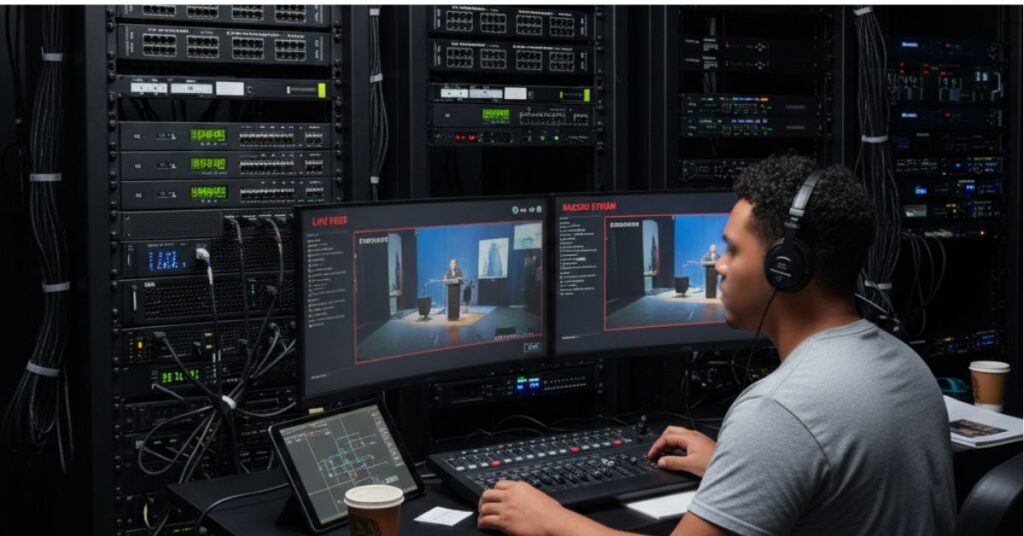
Today, all corporate conferences and business events heavily rely on live streaming, virtual attendees, and cloud-based presentations. Therefore, network reliability has become one of the most critical conference AV challenges.
Some common connectivity issues are:
- Insufficient bandwidth for live streaming.
- Overloaded wi-fi from attendee devices.
- Signal drop due to an unsecured network.
- No dedicated internet lines for AV systems.
A failure in any of the networks may disconnect remote speakers and disrupt global broadcasts. Therefore segregated network, wired backups, and IT-AV coordination in advance of the event day are necessary to solve these conference AV challenges.
4. Lack of Redundancy Planning
One of the most ignored conference AV challenges is the lack of redundancy. Sometimes on the bad days, even the best equipment can fail, and when it does, and you don’t have any backup, then even minor issues can turn into major disruptions.
Examples of missing redundancy include:
- No spare microphones or transmitters
- Single media playback source
- No backup power supply
- Limited replacement cables or adapters
So, always take redundancy as insurance rather than excess. A professional AV production company plans accordingly for failures before they happen. This practice always ensures continuity by drawing attention to technical glitches.
5. Mismatched Equipment and Venue Acoustics
Although every venue has different acoustics and visual qualities. Therefore, using a general approach or equipment without taking the space into consideration can lead to a number of conference AV challenges.
Issues include:
- Echo and reverberation in large halls
- Poor sightlines for screens
- Insufficient brightness in well-lit venues
- Delayed audio reflections
That is why a tailored AV design that accounts for room dimensions, ceiling height, lighting conditions, and audience layout is essential. Thus, common conference AV challenges can be raised by treating all the venues through the same approach.
6. Insufficient Technical Staffing
Manpower and technology go hand in hand to run an event successfully. Understaffing or relying on inexperienced technicians is one of the most underestimated conference AV challenges.
Without adequate staff:
- Issues take longer to diagnose.
- Simultaneous sessions suffer from divided attention.
- Interpreters and presenters lack support.
- Cue coordination becomes chaotic.
At Lucas Productions, our AV professionals can analyse the problem much longer before they actually arise. Therefore, proper staffing ensures that conference AV challenges are resolved quietly to maintain the event professionally.
7. Presentation and Content Compatibility Issues
A large number of conference AV challenges arise from presentation files. Different file formats, unsupported codecs, or last-minute content changes can disrupt the flow and distract audiences.
Common problems include:
- Videos embedded incorrectly
- Fonts not displaying as intended
- Resolution mismatches
- Content designed without aspect ratio considerations
To reduce this, one should standardize submission guidelines and test all the content to reduce these conference AV challenges significantly.
8. Failure to Support Hybrid and Multilingual Needs

These days, conferences are either hybrid or global, which will introduce a new layer of complexity in the execution. However, among the emerging conference AV challenges, most of the issues are related to remote participation and language interpretation.
These include:
- Latency between live and remote feeds
- Interpreter audio bleeding into main channels
- Poor synchronization between the video and the translation
- Inadequate monitoring of language channels
How Our Professional AV Teams Stay Invisible During Successful Events
When an event goes flawlessly, the AV team often goes unnoticed, and that’s the highest compliment in the industry. Our professional AV teams work quietly behind the scenes and analyse all the issues even before they arise. Our invisibility comes from deep preparation, rehearsal, redundant systems, real-time monitoring and clear communication between speakers and organisers.
Our team stays calm, coordinated, and proactive to ensure that the focus of the audience remains exactly where it should be.
Key Takeaways for Event Planners and Organizers
- Seamless AV execution is the result of planning, not luck.
- Every venue requires a customized AV approach.
- Rehearsals and pre-event testing prevent live disruptions.
- Reliable networks and backup systems are non-negotiable.
- Experienced AV teams solve problems before audiences notice.
- When AV feels invisible, the event feels professional.
Conclusion
Conference AV Challenges are not inevitable, but they are preventable. Most of the conference AV challenges arise from insufficient planning, a lack of expertise, or underestimating complexity. Therefore, high-quality production demands more than the equipment; it requires foresight, coordination, and experienced execution.
In a competitive business landscape, conferences are not just any events. They are the moments to build trust and credibility. When Conference AV challenges are handled proactively, your message flows with clarity. It allows speakers to feel supported, audiences to stay engaged, and your story to land the way it was meant to.
If you want your next conference to be remembered for its impact, not for its interruptions, invest in AV planning that works quietly, thoughtfully, and seamlessly behind the scenes. Because when everything runs smoothly, focus remains where it should be: on the story being told by the speaker.